
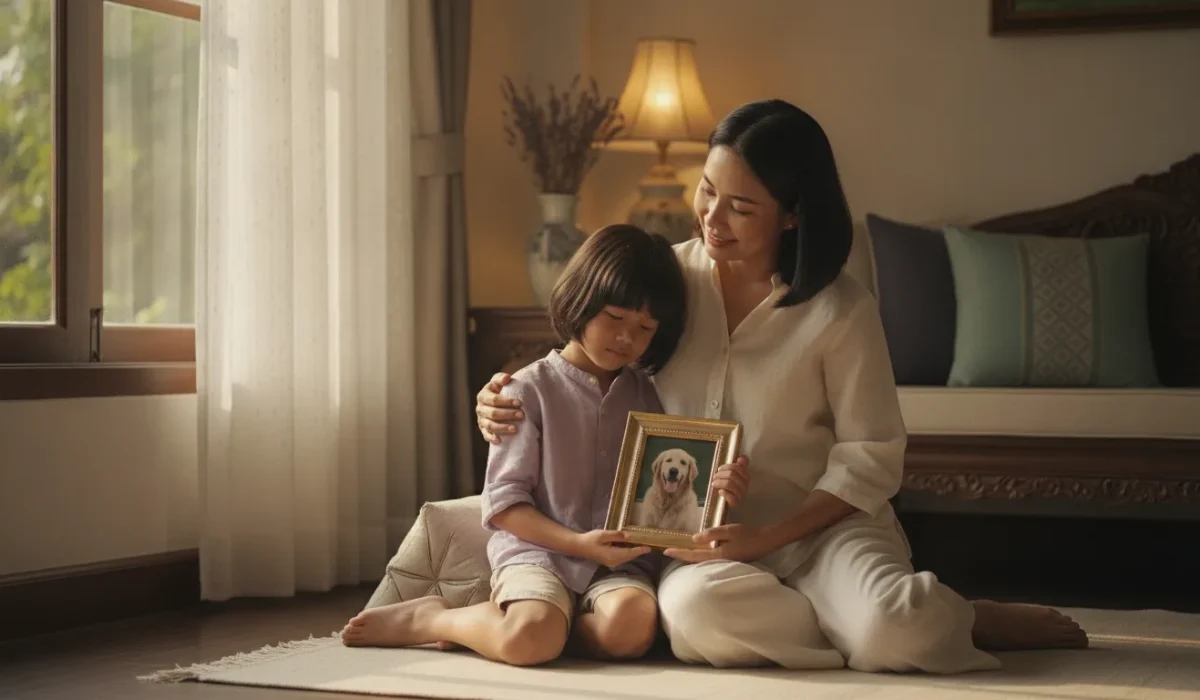
The call usually comes from a parent, and somewhere in the first minute they say it: "I don't know what to tell the kids."
Helping children cope with the death of a pet starts with one decision, made before anyone else in the house is told: use the real word. Say "died". Not "went to sleep", not "we lost him". Children under seven take language literally, and a four-year-old who hears that the dog was put to sleep will think about that at bedtime for weeks. Everything else in this article is easier if that first conversation was honest.
Tell them the same day
If you need us to hold collection for an hour so you can pick a child up from school first, ask. We do that whenever we can. A child who comes home to an empty bed and a vague explanation has lost the pet and the trust at the same time.
Sit down. Use the pet's name. Say what happened in one or two plain sentences: "Mochi was very old and very sick. Her body stopped working, and she died this morning. She isn't in pain, and she can't come back." Then stop talking. The silence that follows feels unbearable to adults and is completely normal for children.
If the death came through euthanasia, say the vet helped the pet die so it wouldn't hurt anymore. Children over about eight can handle the word euthanasia itself. Younger ones need the concept, not the vocabulary.
Expect the same question several times a day for a week. "Is she coming back?" is not a sign the explanation failed. It is how a small child tests whether the answer stays the same.
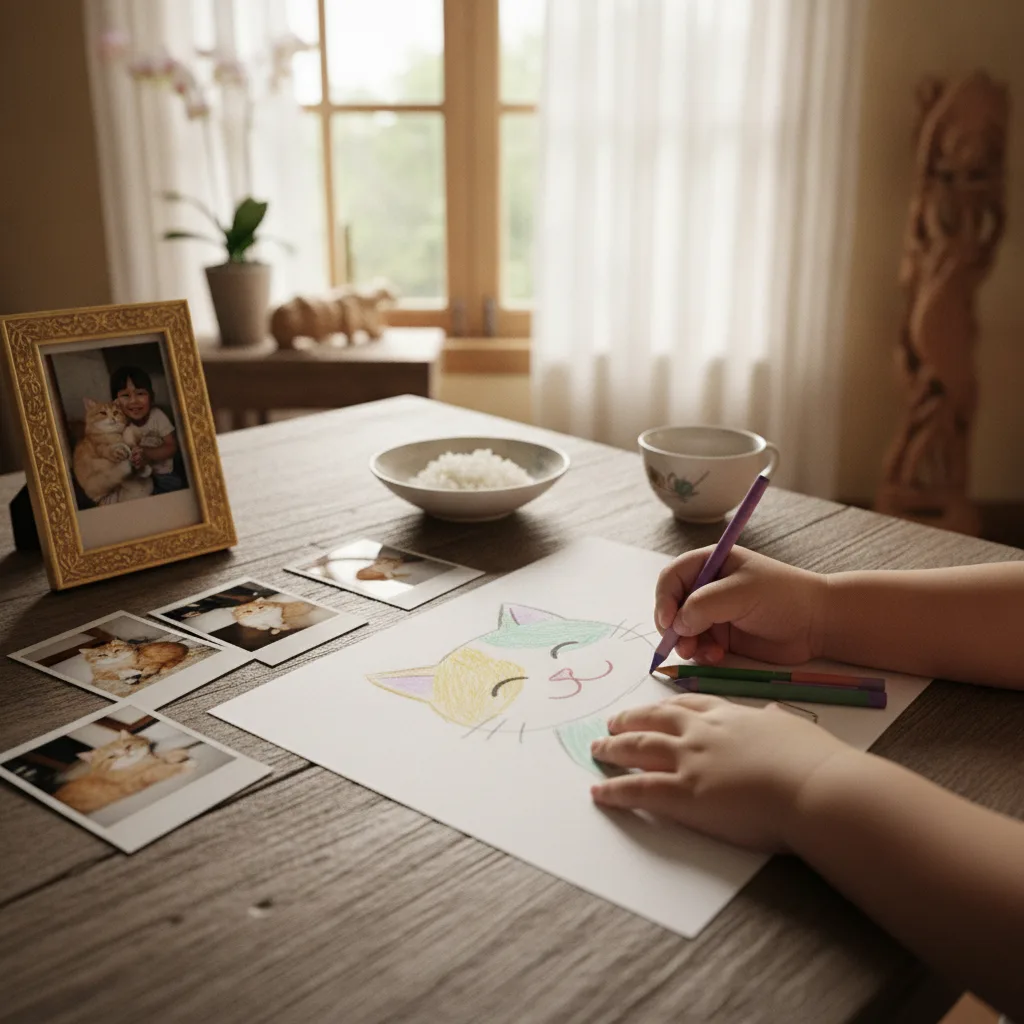
What to say at four, at eight, at fourteen
A four-year-old does not understand permanence. They will ask whether the cat is hungry and when it is coming home. Answer every time, briefly, with the same words. Avoid any phrase that sounds like travel or sleep. Drawing works better than talking at this age.
Between roughly six and ten, children understand that death is final, and that is exactly when guilt arrives. "I forgot to feed him on Tuesday." "I wished he'd stop barking." Say out loud, without being asked, that nothing they did or thought caused this. They will rarely raise it themselves.
Teenagers grieve like adults and hide it like teenagers. The dog they are mourning was probably the one who slept on their bed through every exam and every argument with you. Give them the choice of whether to be present for the collection and the ceremony, and respect whichever answer they give. If a teenager wants to carry the pet to the car themselves, let them.
Should a child come to the temple?
In most Thai families the answer is simply yes, and that instinct is sound.
Every cremation we do is individual, and we collect by car, so the family can ride along to the temple if they want to, children included. The ceremony is short and quiet. A monk chants, there is usually กรวดน้ำ (kruat nam: pouring water slowly from a small vessel while the merit is dedicated), and the pet is placed into the chamber. Children who have been to a grandparent's funeral already know the shape of it. Children who have not find the chanting calming rather than frightening, because the adults around them are calm.
Western parents in Bangkok are often more hesitant, and the concern is usually the same: "Isn't it too much for her?" In practice a child is more unsettled by being left out of something the whole family did without them than by the ceremony itself. A child does not need to watch the chamber door close. They can stand with you for the blessing and then step outside with one parent. That is enough.
If you would rather keep the ceremony small, a monk's blessing can be arranged at home before we collect, and the child can take part in that instead.

Merit-making a child can hold in their hands
Thai Buddhist practice gives a grieving child something most Western grief advice lacks: a job to do.
ทำบุญ (tham bun, making merit) and อุทิศส่วนกุศล (dedicating that merit to the one who died) are things a child can physically perform. Pouring the water. Placing a flower. Lighting an incense stick with a parent's hand over theirs. Thai parents tell a child the pet has ไปเกิดใหม่ (gone to be reborn), and whatever your own beliefs, the idea of doing something for the pet rather than only feeling sad about it changes the shape of a child's grief.
For families who want something to keep, we take paw prints before cremation, and children usually want to hold the finished print. We also make small pendants that hold a pinch of ash. A teenager who will not talk about the dog may still wear one every day.
The urn comes home with us a few days later. Let the children help choose where it sits.
ลอยอังคาร (loy angkhan, releasing the ashes onto water) on the Chao Phraya is the other moment children can own. They scatter the flower petals, they let go of the ashes with you, and the river takes them. For a child who understood "died" but still has nowhere to put the feeling, this is the point at which "where is he now?" finally has an answer they accept.
Expat children in Bangkok: grieving a long way from home
A particular version of this plays out in international-school families in Bangkok. The dog arrived in Bangkok with them from Singapore or London. It was the one constant through two house moves and three schools. The grandparents who would normally help are eight time zones away.
Two practical things. First, let the child tell the grandparents themselves, on a video call, even if it takes three attempts. Second, if there is any chance the family will leave Thailand with the ashes, ask us for a cremation certificate at the time of cremation. Airlines and customs officers ask for it, and a child who has been told "we'll take Biscuit with us when we go" needs that promise to be keepable.
Bilingual households have a wrinkle of their own. A Thai parent might tell the child the cat has gone to be reborn while the other parent says it has simply died. Children cope fine with two framings as long as neither parent contradicts the other in front of them. Agree beforehand which words each of you will use.
What the next month looks like
Grief in a child rarely looks like grief. It looks like stomach aches on school mornings, or a teenager who is suddenly furious about the dishwasher. Keep the routines exactly as they were, including the hard ones like the school run, and name what you are seeing: "I think you miss her. I do too."
Do not remove the bed and bowls the day after. Let the child decide when, and do it together.
And never say "we'll get you another one" in the first weeks, however well meant. The child hears that the pet was replaceable, which means they are too. The question of whether and when to get another pet after losing one deserves its own conversation, months from now, started by the child.
Most children are visibly steadier within a few weeks. Grief resurfaces at birthdays, and at the first Songkran without the dog in the water fight. That is a return, not a relapse. We have also written about how long pet grief lasts.
When to call someone other than us
We are cremation people, not therapists, and we say so to every parent who asks. What we do have is a referral list of counsellors in Bangkok who specialise in pet loss, and we pass it to any parent who asks.
Ask for that referral if, a month or more on, your child still cannot sleep, has stopped seeing friends, keeps talking about dying themselves, or has gone completely silent about a pet they adored. One or two sessions is usually all it takes to give a child permission to say what they have been protecting you from.
You can read more about what that looks like on our emotional support page, or message us on LINE at @peacefulpawsth and ask. The line +66-95-535-6335 is answered around the clock, and the first question many parents ask on it is still the one at the top of this article. We will help you find the words.
Because every goodbye matters.